Showing posts with label astronomy. Show all posts

Wednesday, June 22, 2011

Zen and the Art of Astronomy


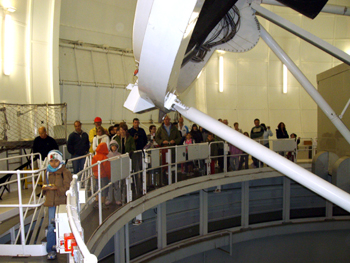
Today I showed two Buddhist monks (plus three of their friends) around the biggest telescope in the world. The senior one is the professor of Buddhist Philosophy at the University of Varanasi, in India. Unfortunately I can't remember his name since it was so exotic to me.

I did a bit of a double take when I saw that the university professor was wearing Tibetan robes, like the Dalai Lama. It's not something you often see on La Palma. If anything, the observatory dress code learns towards slightly scruffy, since quite a lot of the people there have been up all night, are living out of suitcases, and are more interested in exoplanets than fashion anyway.

Well, it didn't take long to see past the robes to the people, and to find out that they were very nice. So I showed them around and gave the talk for people who are intelligent, but don't know much science, and they were all very appreciative. And as usual with small groups, we all took photos of each other.

When we got outside, we were all thirsty. We had plenty of water but only two cups. I was just about to go back into the building in search of cups when the monks showed us how to share cups hygienically - you don't touch it with your lips. I got soaked on my first try, but it was only water on a hot day, so that was no problem. And then I got the hang of it.

When I got up this morning, I certainly wasn't expecting drinking lessons from a Buddhist monk.

Thursday, June 16, 2011

A Blood Red Moon

Total eclipse of the moon from Llano de la Venta viewpointA Blood red eclipse of the moon from Llano de la Venta viewpoint

La Palma has beautiful dark skies, so I was hoping for a really good view of last night's lunar eclipse. But looking at the low cloud along the horizon, I decided to drive up to the star party at Llano de la Venta, one of La Palma's astronomical viewpoints. In practice, an astronomical vciewpoint means parking space, level ground suitable for tripods, a signpost pointing to the pole star, and an information panel.

Signpost to the  Pole Star, Breña Alta, La Palma.How far to the Pole Star?

Astrotour was offering free stargazing, courtesy of the island government. These viewpoints can be pretty cold in winter - this one is at 1,300 m - but last night it was quite balmy. The first surprise was the number of people who'd turned out. The next was the discovery that we had trees blocking the view of Mt Teide - and the moon was due to rise from behind Teide. It's a good thing I didn't have a saw with me. I'd have been very tempted, which would have been sheer vandalism, of course. So there wasn't anywhere sensible to put my tripod.


We got a splendid view of the moon, when it rose. I found I could get halfway decent photos by setting manual focus (to infinity) and jamming the camera against the Polaris signpost to hold it steady for the 1-second exposures.

One woman beside me was grumbling that she couldn't get any photos with her DSLR, and I confess I felt rather smug. Then she realised that I was getting photos with my compact, and the grumbling turned bitter.

I said mildly, "Well it's a rather good compact and I have practised." (This is an understatement. I've put in thousands of hours of photography practice.)

But she still clearly felt that having a DSLR ought to guarantee good photos, even if you didn't know how to set it to manual focus. I looked, but I couldn't see how to do it either. (I found out later that Canon camera have the manual focus on the lens, not the body)

Then the International Space Station zoomed overhead, looking gorgeous. (Every time they add more solar panels, the ISS gets brighter and brighter). You can imagine the DSLR's owner's reaction when I got a photo of that too, on my itty-bitty compact.

And to round things off nicely, Astrotour pointed their 10" telescope at Saturn, so we could all see the rings. They're as stunning as ever.

You could say it was a heavenly evening.

The International  Space Station passing over La Palma, seen from Breña AltaThe International Space Station passing over Breña Baja

Thursday, September 11, 2008

R.I.P. Florian Goebel

Florien was the project manager for MAGIC II, the second of the huge Cherenkov telescopes at the Roque de los Muchachos. The telescope was due to be inaugurated next week, on the 19th. That's been delayed now, because somehow he fell from the prime focus tower in the dark last night. The tower is about ten metres (33ft) high, and Florien's dead.

I only ever had one conversation with him. He must have been very busy, but he took time out to help me with a magazine article. I always think that's the acid test of character: how you treat people who are of no possible use to you.

My husband worked for him for three weeks, fitting mirror segments to MAGIC II, and said several times how nice he was.

My sincere sympathies to his family.

Friday, May 09, 2008

Tour Guiding again


This morning I took a party of kids around the Herschel Telescope. It was the first time for about 6 months, so I felt rusty, but it went fairly well. It really helped that the tech staff moved the dome and telescope for us.

The bad part was that I'd forgotten how cold the wind can be up there, and I wasn't dressed for it at all.

Wednesday, August 15, 2007

A Magical Perk.


Yesterday I was guide for another two telescope visits. Unusually, they were afternoon visits. First I showed a sick boy and his mother around, and then a group of British amateur astronomers. The best bit was that after the amateurs finished seeing the Herschel, they were going to visit the MAGIC telescope.

I hadn't seen that one yet, so I tagged along.

MAGIC stands for Major Atmospheric Gamma-ray Imaging Cherenkov Telescope. Instead of one big mirror like the Herschel, it has over 1,000 mirrors 50cm square to form a compound mirror 17m (56 ft) across.

It's not an optical telescope. Instead of observing visible light, it's looking for gamma rays. The snag is that gamma rays don't get through the earth's atmosphere, so it's actually looking for the cascade of particle in the upper atmosphere caused by the gamma rays.

MAGIC looks like a basket on its side, doesn't it? But the whole basket weighs about 60 tons and can slew to point at any part of the sky within 20 seconds. This is important, because the bursts only last for a few minutes.

I got to go up the green platform on the left of the picture above, and then I could see myself in the huge mirror.